
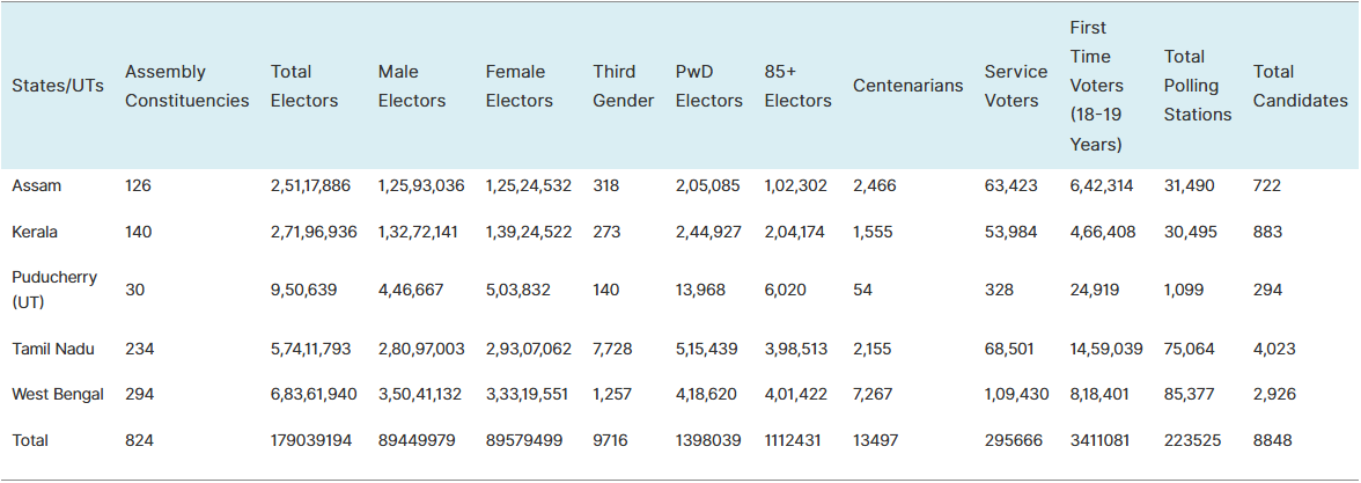
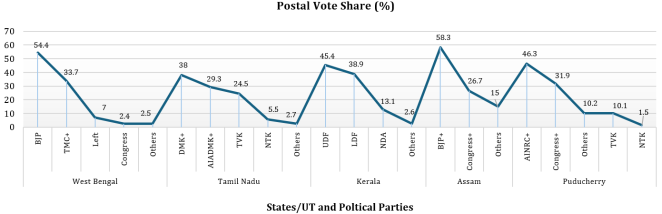
Postal ballots have emerged as a crucial mechanism of electoral participation in India, particularly for government employees, armed forces personnel, election-duty staff, persons with disabilities, essential service workers, electors above the age of 85 years, and other categories of voters who are unable to participate through conventional polling methods. Understanding postal ballot behaviours is weighty because it provides insights into the political preferences of influential administrative groups and contributes to broader studies of electoral dynamics. However, existing electoral research has largely focused on general voter behaviour and party performance through Electronic Voting Machine (EVM) based results in general, while limited attention has been given to the voting patterns of postal ballot voters in particular. This study aims to analyse the voting patterns of postal ballot voters in the 2026 Legislative Assembly elections of Assam, Kerala, Puducherry, Tamil Nadu, and West Bengal by comparing postal vote shares with overall EVM-based electoral outcomes. The study adopts a comparative quantitative approach using Election Commission of India data on postal ballots, EVM votes, and alliance-wise electoral performances with their previous election trends. The key findings reveal significant variations between postal and general voting trends. In Kerala, and Tamil Nadu, West Bengal changes in postal vote shares (2026) reflected shifts in a way from incumbent alliances with LDF 38.9% and DMK+ 38% and TMC+ 33.7%, against to their previous election (2021) postal ballot vote share to 48.7%, 62.2%, and 46.9% respectively witnessed significant decline, whereas Assam and Puducherry demonstrated different patterns, where postal ballot trends did not always correspond directly with overall electoral outcomes. The study highlights the distinct role of postal ballots and its largest share of service voters as an informed electoral segment and offers a unique perspective on bureaucratic electoral preferences and enhances understanding of occupational groups in contemporary Indian electoral politics.
| Published in | Journal of Political Science and International Relations (Volume 9, Issue 3) |
| DOI | 10.11648/j.jpsir.20260903.16 |
| Page(s) | 188-198 |
| Creative Commons |
This is an Open Access article, distributed under the terms of the Creative Commons Attribution 4.0 International License (http://creativecommons.org/licenses/by/4.0/), which permits unrestricted use, distribution and reproduction in any medium or format, provided the original work is properly cited. |
| Copyright |
Copyright © The Author(s), 2026. Published by Science Publishing Group |
Postal Ballots, Bureaucratic Voting Behaviour, Voting Patterns, Service Voters
State/UT | EVM votes (in cr.) | Postal Votes (in lakh) | Total Votes (in cr.) | % of Postal Votes |
|---|---|---|---|---|
Assam | 2.15 | 1.31 | 2.17 | 0.6 |
Kerala | 2.12 | 3.52 | 2.16 | 1.6 |
Tamil Nadu | 4.88 | 5.22 | 4.93 | 1.1 |
West Bengal | 6.33 | 4.66 | 6.38 | 0.7 |
Puducherry (UT) | 0.09 | 0.12 | 0.09 | 1.4 |
State/UT | Incumbent Party/Alliance | Postal Vote Share (%) (2021) | Differences (2021-2026) | Postal Vote Share (%) (2026) | EVM Votes% | Pattern | Election Result (Power Status of Political Parties) |
|---|---|---|---|---|---|---|---|
Assam | BJP+ | 52.7 | 5.6 | 58.3 | 47.6 | Increased | Retained in Power |
Kerala | LDF | 48.5 | -9.6 | 38.9 | 36.8 | Decreased | Lost Power |
Puducherry (UT) | AINRC+ | 47.5 | -1.22 | 46.3 | 38.6 | Slightly Decreased | Retained in Power |
Tamil Nadu | DMK+ | 62.2 | -24.2 | 38.0 | 31.3 | Decreased Significantly | Lost Power |
West Bengal | TMC+ | 46.9 | -13.2 | 33.7 | 41.1 | Decreased | Lost Power |
AIADMK | All India Anna Dravida Munnetra Kazhagam |
AINRC | All India N.R. Congress |
BJP | Bharatiya Janata Party |
BJP+ | Bharatiya Janata Party-led Alliance |
Congress+ | Indian National Congress-led Alliance |
DA | Dearness Allowance |
DMK Dravida | Munnetra Kazhagam |
DMK+ | Dravida Munnetra Kazhagam-led Alliance |
DR | Dearness Relief |
ECI | Election Commission of India |
ESA | Earned Salary Advance |
LDF | Left Democratic Front |
NDA | National Democratic Alliance |
NTK | Naam Tamilar Katchi |
SLC | Salary-Linked Credit |
TMC | All India Trinamool Congress |
TVK | Tamilaga Vettri Kazhagam |
UDF | United Democratic Front |
UT | Union Territory |
| [1] | Andersen, D., & Cornell, A. (2023). Voting for bureaucracy? Contestation, suffrage and meritocracy. European Journal of Political Research, 62(4), 1122-1145. |
| [2] | Bennett, J. T., & Orzechowski, W. P. (1983). The voting behavior of bureaucrats: Some empirical evidence. Public Choice, 41(2), 271-283. |
| [3] | Bhatti, Y., & Hansen, K. M. (2013). Public employees lining up at the polls—the conditional effect of living and working in the same municipality. Public Choice, 156(3), 611-629. |
| [4] | Boyne, G. A. (1998). Party competition and local spending decisions. British Journal of Political Science, 28(1), 185-222. |
| [5] | Branton, R. P. (2003). Examining individual-level voting behavior on state ballot propositions. Political Research Quarterly, 56(3), 367-377. |
| [6] | Buchanan, J. M., & Tullock, G. (1965). The calculus of consent: Logical foundations of constitutional democracy (Vol. 100). University of Michigan press. |
| [7] | Bush, W. C., & Denzau, A. T. (1977). The voting behavior of bureaucrats and public sector growth. Budgets and bureaucrats: The sources of government growth, 90-99. |
| [8] | Campbell A., Converse P., Miller W., Stokes D. E. (1960). The American voter. New York, NY: John Wiley. |
| [9] | Cancela, J., & Geys, B. (2016). Explaining voter turnout: A meta-analysis of national and subnational elections. Electoral studies, 42, 264-275. |
| [10] | Corey, E. C., & Garand, J. C. (2002). Are government employees more likely to vote?: An analysis of turnout in the 1996 US national election. Public Choice, 111(3), 259-283. |
| [11] | Dalton, R. J. (2017). The participation gap: Social status and political inequality. Oxford University Press. |
| [12] | Dey, S. (2026, May 5). 6 Reasons Why Mamata Banerjee Lost Bhabanipur To BJP’s Suvendu Adhikari. Www.ndtv.com; NDTV. |
| [13] | Downs, A. (1957). An economic theory of democracy. Harper and Row, 28. |
| [14] | Duenas-Cid, D., Spycher-Krivonosova, I., Krimmer, R., & Muchiri, G. (2026). From Postal Ballots to E-Voting: Renewing the Definition and Typology of Convenience Voting. Election Law Journal: Rules, Politics, and Policy, 15331296251411801. |
| [15] | Fiva, J. H., Halse, A., & Natvik, G. J. (2012). Local government dataset. Dataset available from esop. uio. no. |
| [16] | Frey, B. S., & Pommerehne, W. W. (1982). How powerful are public bureaucrats as voters?. Public Choice, 38(3), 253-262. |
| [17] | Funk, P. (2010). Social incentives and voter turnout: evidence from the Swiss mail ballot system. Journal of the European economic association, 8(5), 1077-1103. |
| [18] | Garand, J. C., Parkhurst, C. T., & Seoud, R. J. (1991). Bureaucrats, policy attitudes, and political behavior: Extension of the bureau voting model of government growth. Journal of Public Administration Research and Theory, 1(2), 177-212. |
| [19] | Geys, B., & Sørensen, R. J. (2022). Public sector employment and voter turnout. American Political Science Review, 116(1), 367-373. |
| [20] | Goplerud, M., & Smith, D. M. (2023). Who answers for the government? Bureaucrats, ministers, and responsible parties. American Journal of Political Science, 67(4), 963-978. |
| [21] | Government of Assam, Finance Department. (2026, February 7). Expression of interest (EOI) for earned salary advance and salary-linked credit for regular government employees of Assam. Retrieved May 5, 2026, from Government of Assam Finance Department. |
| [22] | Gramlich, E. M., & Rubinfeld, D. L. (1982). Voting on public spending: Differences between public employees, transfer recipients, and private workers. Journal of Policy Analysis and Management, 1(4), 516-533. |
| [23] | Hansford, T. G., & Gomez, B. T. (2010). Estimating the electoral effects of voter turnout. American political Science review, 104(2), 268-288. |
| [24] | Harbers, I., Richetta, C., & Van Wingerden, E. (2023). Shaping electoral outcomes: Intra-and anti-systemic violence in Indian assembly elections. British Journal of Political Science, 53(2), 424-440. |
| [25] | Herrnson, P. S., Hanmer, M. J., & Koh, H. Y. (2019). Mobilization around new convenience voting methods: A field experiment to encourage voting by mail with a downloadable ballot and early voting. Political Behavior, 41(4), 871-895. |
| [26] | Hong, J., & Mei, C. (2026). Revisiting the Core of Policy Feedback Theory: A Systematic Review. Review of Policy Research, 43(3), e70095. |
| [27] | Hortala-Vallve, R., Meriläinen, J., & Tukiainen, J. (2024). Pre-electoral coalitions and the distribution of political power. Public Choice, 198(1), 47-67. |
| [28] | Ibenskas, R., & Zurita-Tapia, J. (2025). Pre-electoral coalitions. In Handbook on Coalition Politics (pp. 312-330). Edward Elgar Publishing. |
| [29] | James, T. S. (2011). Fewer costs, more votes? United Kingdom innovations in election administration 2000-2007 and the effect on voter turnout. Election Law Journal: Rules, Politics, and Policy, 10(1), 37-52. |
| [30] | Jensenius, F. R., & Verniers, G. (2017). Studying Indian politics with large-scale data: Indian election data 1961-today. Studies in Indian Politics, 5(2), 269-275. |
| [31] | Johnson, R. N., & Libecap, G. D. (1991). Public sector employee voter participation and salaries. Public Choice, 137-150. |
| [32] | Karp, J. A., & Banducci, S. A. (2000). Going postal: How all-mail elections influence turnout. Political behavior, 22(3), 223-239. |
| [33] | Luechinger, S., Rosinger, M., & Stutzer, A. (2007). The impact of postal voting on participation: Evidence for Switzerland. Swiss Political Science Review, 13(2), 167-202. |
| [34] | Niskanen, J. (2017). Bureaucracy and representative government. Routledge. |
| [35] | Norris, P. (2002). E-voting as the magic ballot?. Available at SSRN 336542. |
| [36] | Norris, P. (2003). Will new technology boost turnout? Evaluating experiments in e-voting v. all-postal voting facilities in UK local elections. Evaluating Experiments in E-Voting V. All-Postal Voting Facilities in UK Local Elections (August 2003). |
| [37] | Patterson, S. C., & Caldeira, G. A. (1985). Mailing in the vote: Correlates and consequences of absentee voting. American Journal of Political Science, 766-788. |
| [38] | Pennington, M. (2000). Public choice theory and the politics of urban containment: voter-centred versus special-interest explanations. Environment and Planning C: Government and Policy, 18(2), 145-162. |
| [39] | Rana, M. S. (2006). India Votes: Lok Sabha & Vidhan Sabha Elections 2001-2005. Sarup & Sons. |
| [40] | Ritz, A. (2015). Public service motivation and politics: Behavioural consequences among local councillors in Switzerland. Public Administration, 93(4), 1121-1137. |
| [41] | Rosenbloom, D. H. (2014). Federal service and the constitution: The development of the public employment relationship. Georgetown University Press. |
| [42] | Rounce, A. D., & Levasseur, K. (2015). Public, private, and non-profit sector employees: Voting behaviour and ideology in the 2011-2012 provincial elections. Canadian Political Science Review, 9(1), 128-146. |
| [43] | Serra, G. (2015). No polarization in spite of primaries: a median voter theorem with competitive nominations. The Political Economy of Governance: Institutions, Political Performance and Elections, 211-229. |
| [44] | Singh, B. (2026, March 15). Assam launches Earned Salary Advance (ESA) & Salary Linked Credit (SLC) for employees. The Economic Times. |
| [45] | Singh, N. K., Mishra, P., Mukherjee, S., & Nair, A. (2025). All the Growth We Cannot See: Staggered Elections in World’s Largest Democracy. |
| [46] | Smith, P., Fosh, P., Martin, R., Morris, H., & Undy, R. (1993). Ballots and Union Government in the 1980s. British Journal of Industrial Relations, 31(3), 365-382. |
| [47] | Verba, S., Schlozman, K. L., & Brady, H. E. (1995). Voice and equality: Civic voluntarism in American politics. Harvard University Press. |
| [48] | Watson, R. (1997). Politics and public administration: A political profile of local bureaucrats in Alabama. Administration & Society, 29(2), 189-200. |
| [49] | Zaborowski, M. (2021). Postal ballot in unconsolidated democracy: Poland's case. Transforming Government: People, Process and Policy, 15(3), 360-373. |
APA Style
Rout, S., Dutta, R., Palai, P. (2026). Postal Ballot Voting Patterns in India: A Comparative Analysis of State Assembly Elections 2026. Journal of Political Science and International Relations, 9(3), 188-198. https://doi.org/10.11648/j.jpsir.20260903.16
ACS Style
Rout, S.; Dutta, R.; Palai, P. Postal Ballot Voting Patterns in India: A Comparative Analysis of State Assembly Elections 2026. J. Polit. Sci. Int. Relat. 2026, 9(3), 188-198. doi: 10.11648/j.jpsir.20260903.16
@article{10.11648/j.jpsir.20260903.16,
  author = {Suryakanta Rout and Rajshree Dutta and Priyambada Palai},
  title = {Postal Ballot Voting Patterns in India: A Comparative Analysis of State Assembly Elections 2026},
  journal = {Journal of Political Science and International Relations},
  volume = {9},
  number = {3},
  pages = {188-198},
  doi = {10.11648/j.jpsir.20260903.16},
  url = {https://doi.org/10.11648/j.jpsir.20260903.16},
  eprint = {https://article.sciencepublishinggroup.com/pdf/10.11648.j.jpsir.20260903.16},
  abstract = {Postal ballots have emerged as a crucial mechanism of electoral participation in India, particularly for government employees, armed forces personnel, election-duty staff, persons with disabilities, essential service workers, electors above the age of 85 years, and other categories of voters who are unable to participate through conventional polling methods. Understanding postal ballot behaviours is weighty because it provides insights into the political preferences of influential administrative groups and contributes to broader studies of electoral dynamics. However, existing electoral research has largely focused on general voter behaviour and party performance through Electronic Voting Machine (EVM) based results in general, while limited attention has been given to the voting patterns of postal ballot voters in particular. This study aims to analyse the voting patterns of postal ballot voters in the 2026 Legislative Assembly elections of Assam, Kerala, Puducherry, Tamil Nadu, and West Bengal by comparing postal vote shares with overall EVM-based electoral outcomes. The study adopts a comparative quantitative approach using Election Commission of India data on postal ballots, EVM votes, and alliance-wise electoral performances with their previous election trends. The key findings reveal significant variations between postal and general voting trends. In Kerala, and Tamil Nadu, West Bengal changes in postal vote shares (2026) reflected shifts in a way from incumbent alliances with LDF 38.9% and DMK+ 38% and TMC+ 33.7%, against to their previous election (2021) postal ballot vote share to 48.7%, 62.2%, and 46.9% respectively witnessed significant decline, whereas Assam and Puducherry demonstrated different patterns, where postal ballot trends did not always correspond directly with overall electoral outcomes. The study highlights the distinct role of postal ballots and its largest share of service voters as an informed electoral segment and offers a unique perspective on bureaucratic electoral preferences and enhances understanding of occupational groups in contemporary Indian electoral politics.},
 year = {2026}
}
TY  - JOUR
T1  - Postal Ballot Voting Patterns in India: A Comparative Analysis of State Assembly Elections 2026
AU  - Suryakanta Rout
AU  - Rajshree Dutta
AU  - Priyambada Palai
Y1  - 2026/08/10
PY  - 2026
N1  - https://doi.org/10.11648/j.jpsir.20260903.16
DO  - 10.11648/j.jpsir.20260903.16
T2  - Journal of Political Science and International Relations
JF  - Journal of Political Science and International Relations
JO  - Journal of Political Science and International Relations
SP  - 188
EP  - 198
PB  - Science Publishing Group
SN  - 2640-2785
UR  - https://doi.org/10.11648/j.jpsir.20260903.16
AB  - Postal ballots have emerged as a crucial mechanism of electoral participation in India, particularly for government employees, armed forces personnel, election-duty staff, persons with disabilities, essential service workers, electors above the age of 85 years, and other categories of voters who are unable to participate through conventional polling methods. Understanding postal ballot behaviours is weighty because it provides insights into the political preferences of influential administrative groups and contributes to broader studies of electoral dynamics. However, existing electoral research has largely focused on general voter behaviour and party performance through Electronic Voting Machine (EVM) based results in general, while limited attention has been given to the voting patterns of postal ballot voters in particular. This study aims to analyse the voting patterns of postal ballot voters in the 2026 Legislative Assembly elections of Assam, Kerala, Puducherry, Tamil Nadu, and West Bengal by comparing postal vote shares with overall EVM-based electoral outcomes. The study adopts a comparative quantitative approach using Election Commission of India data on postal ballots, EVM votes, and alliance-wise electoral performances with their previous election trends. The key findings reveal significant variations between postal and general voting trends. In Kerala, and Tamil Nadu, West Bengal changes in postal vote shares (2026) reflected shifts in a way from incumbent alliances with LDF 38.9% and DMK+ 38% and TMC+ 33.7%, against to their previous election (2021) postal ballot vote share to 48.7%, 62.2%, and 46.9% respectively witnessed significant decline, whereas Assam and Puducherry demonstrated different patterns, where postal ballot trends did not always correspond directly with overall electoral outcomes. The study highlights the distinct role of postal ballots and its largest share of service voters as an informed electoral segment and offers a unique perspective on bureaucratic electoral preferences and enhances understanding of occupational groups in contemporary Indian electoral politics.
VL  - 9
IS  - 3
ER  -
Department of Social Science, Fakir Mohan University, Balasore, India
Department of Social Science, Fakir Mohan University, Balasore, India
Department of Social Science, Fakir Mohan University, Balasore, India

Information



 Share This Article
 Twitter
 Linked In
 Facebook
 Copy
Copy Download